Learn Esperanto by reading.
Cloud is in beta · self-hosting is free forever
- Native speakers
- ~1,000 (raised bilingually)
- Difficulty (FSI)
- Not FSI rated
- To proficiency
- ~200 hours
Reasons to start.
Built to be learnable: no irregular verbs, no grammatical gender, one plural ending, and stress always on the second-to-last syllable.
Systematic word-building means vocabulary compounds instead of multiplying — sana is “healthy”, malsana “ill”, malsanulo “a patient”, malsanulejo “a hospital”.
A worldwide community far out of proportion to its size, with meetings on every continent, a hosting network for travellers, and a large body of original and translated literature.
Bonus: Not mutually intelligible with any national language, but the roots are mostly Romance and Germanic, so an English speaker recognises a surprising amount of the vocabulary on sight.
The honest version.
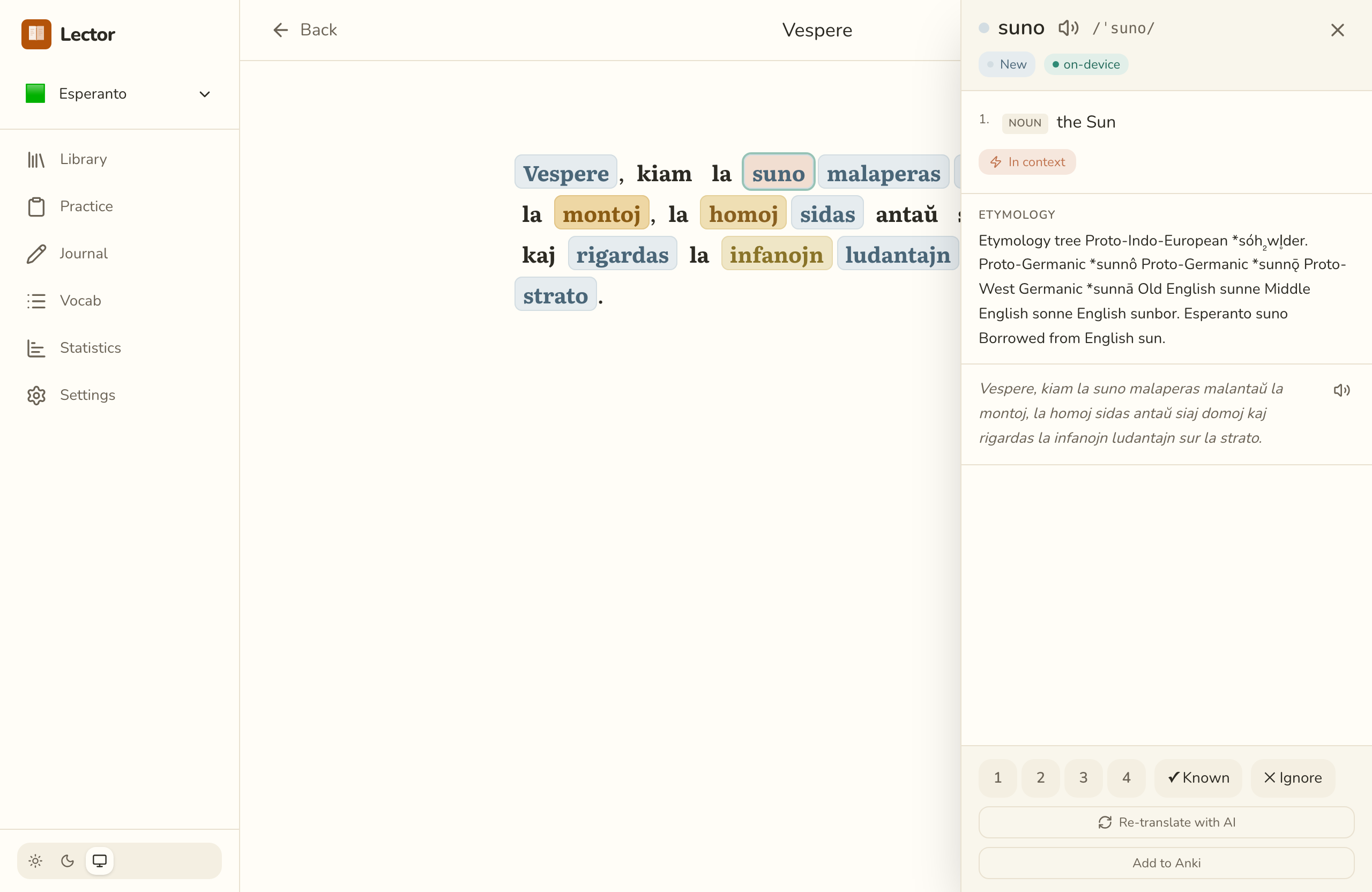
Vespere, kiam la suno malaperas malantaŭ la montoj, la homoj sidas antaŭ siaj domoj kaj rigardas la infanojn ludantajn sur la strato.
In the evening, when the sun disappears behind the mountains, people sit in front of their houses and watch the children playing in the street.
Read it. Practice it. Remember it.
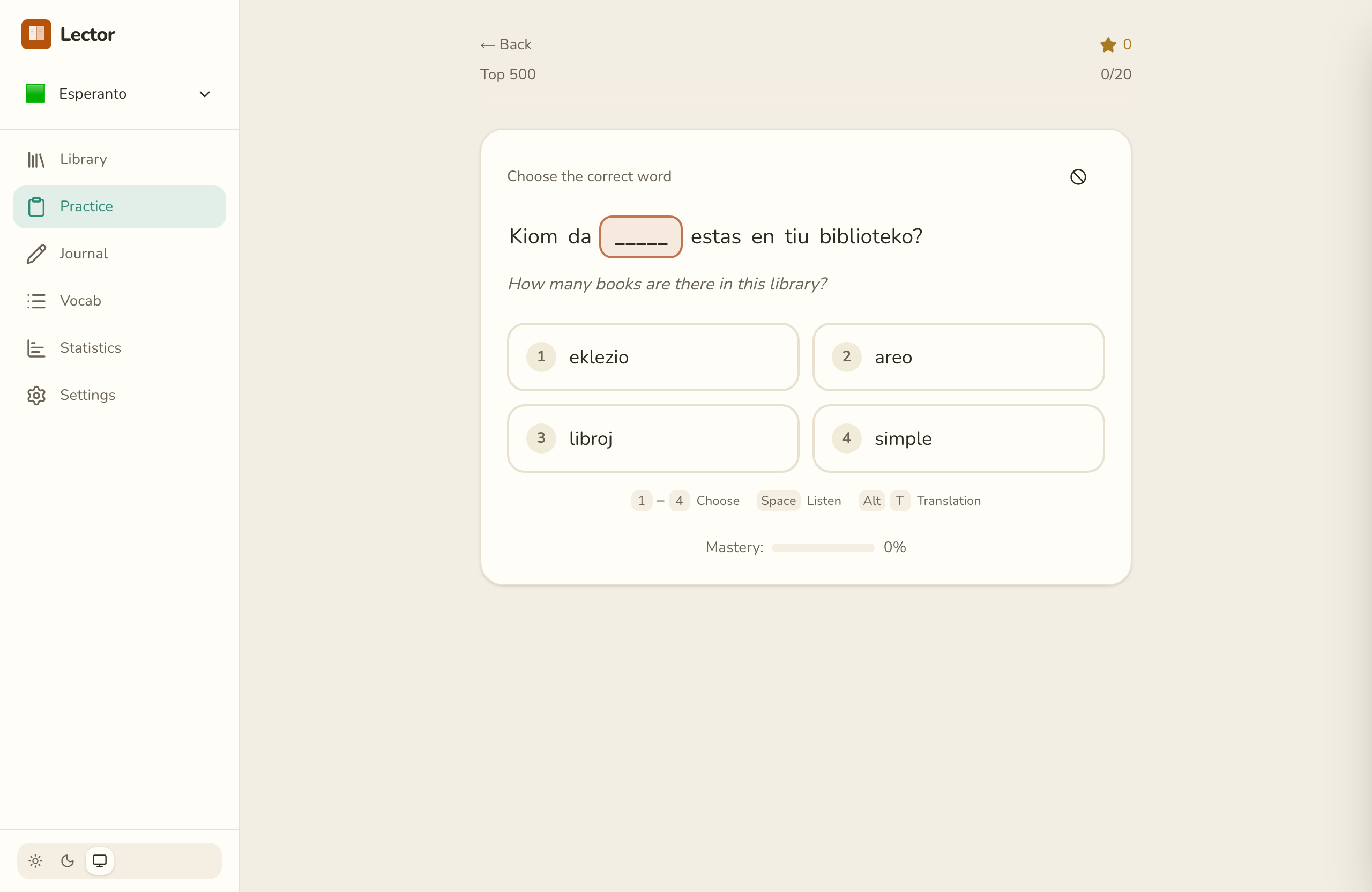
Drill the words that matter first.
Free resources to get you started.
Is Esperanto hard to learn?
No — it is the easiest language on this list by a wide margin. It was designed to be regular: no irregular verbs, no grammatical gender, one plural ending, predictable stress, and one letter for each sound.
How long does it take to learn Esperanto?
The FSI does not rate Esperanto, so there is no official figure. Claude Piron's estimate of roughly 180 to 220 hours to mastery is the most-cited one, and most learners can read simple Esperanto after a few weeks of daily practice.
What is the best way to learn Esperanto?
Learn the affix system early, then read as much as you can. Because malsanulejo is built out of parts you already know, most new vocabulary is recognised rather than memorised. Frequency-ordered practice and spaced repetition cover the roots.
Can I learn Esperanto for free?
Yes, and more easily than for most languages. The community publishes its courses, dictionaries and literature freely, and free or self-hosted reading and flashcard tools cover the rest.
Learning Esperanto? You're in good company.
Start reading Esperanto today.
Open source to self-host for free, or on our cloud in a click.