Learn Turkish by reading.
Cloud is in beta · self-hosting is free forever
- Native speakers
- ~85 million
- Difficulty (FSI)
- Category III
- To proficiency
- ~1,100 hours
Reasons to start.
Around 85 million native speakers and about 91 million in total, official in Türkiye and Cyprus and spoken across the Balkans, Germany and Central Asia.
Grammar with almost no irregularity: no grammatical gender, no articles, and endings that follow the same rules every time.
A gateway to the wider Turkic family — Azerbaijani is largely mutually intelligible, and Turkmen, Uzbek and Kazakh share much of the structure.
Bonus: Largely mutually intelligible with Azerbaijani, and close enough to Turkmen, Gagauz and Crimean Tatar that they become far easier once you know Turkish.
The honest version.
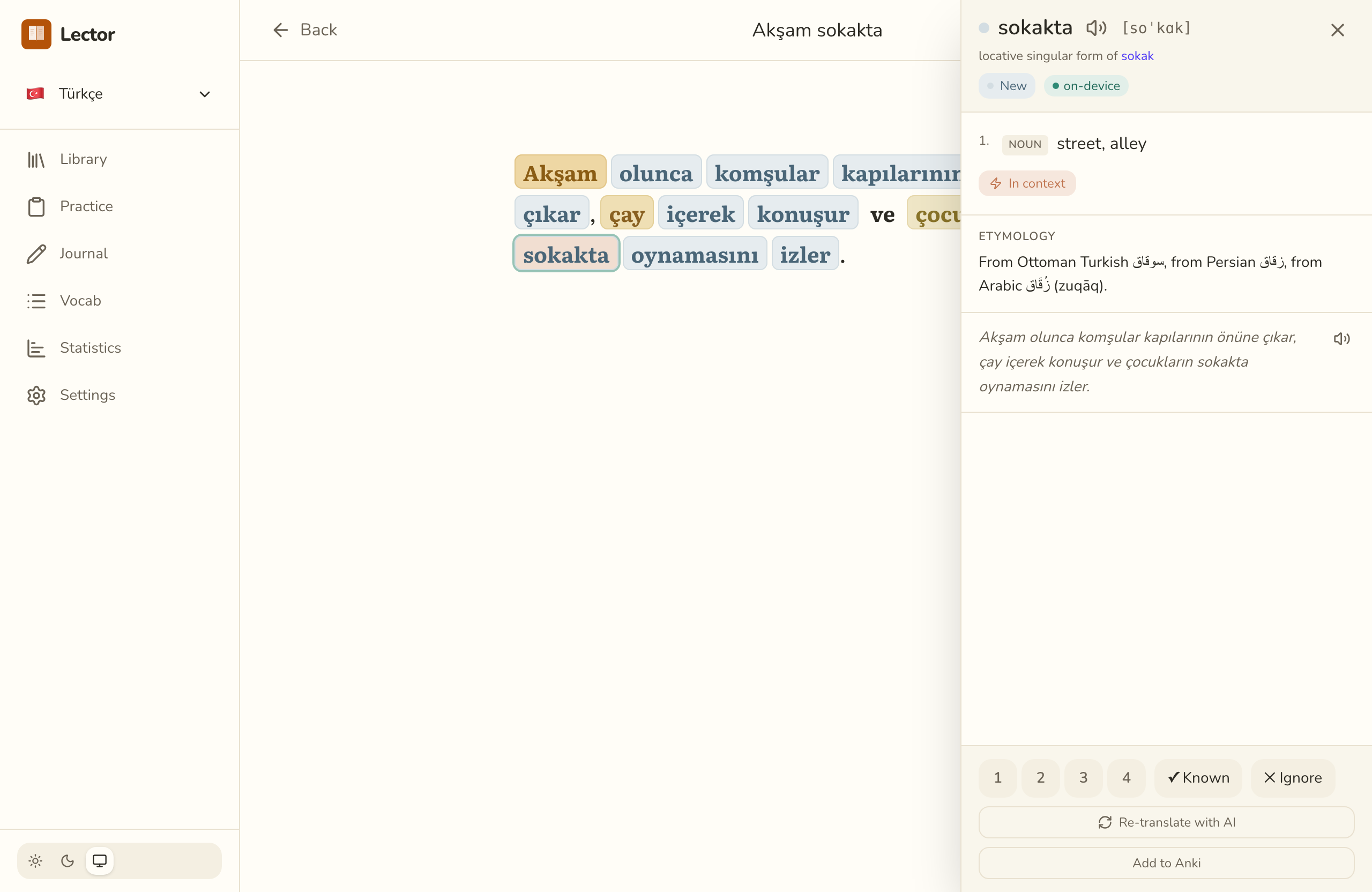
Akşam olunca komşular kapılarının önüne çıkar, çay içerek konuşur ve çocukların sokakta oynamasını izler.
When evening comes, the neighbours come out in front of their doors, talk over tea, and watch the children playing in the street.
Read it. Practice it. Remember it.
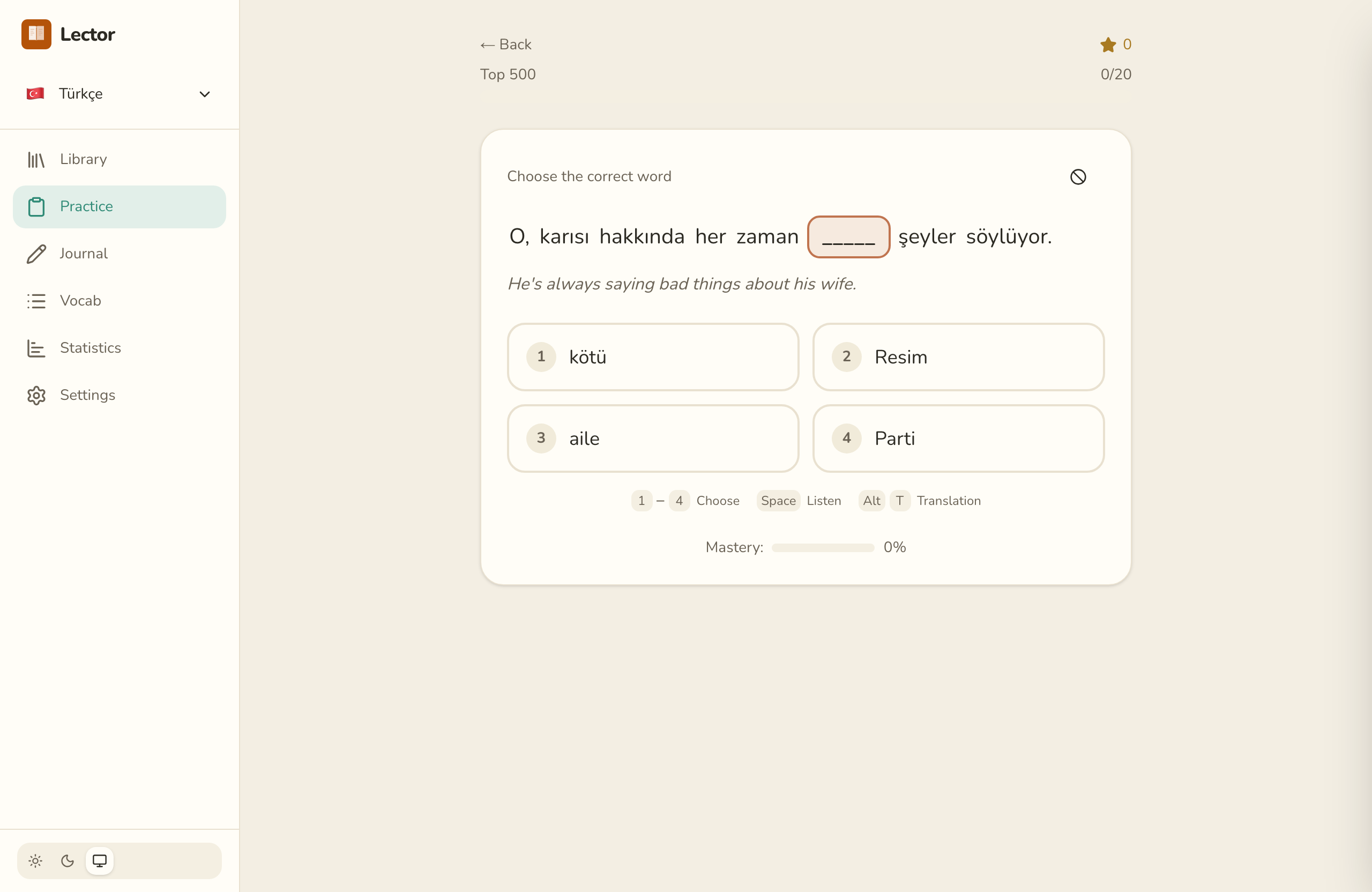
Drill the words that matter first.
Free resources to get you started.
Is Turkish hard to learn?
Turkish is challenging but unusually consistent. There is no grammatical gender, no articles, and hardly any irregularity. What takes practice is agglutination — words that stack plural, possessive and case endings together — and vowel harmony.
How long does it take to learn Turkish?
The FSI places Turkish in Category III, at roughly 1,100 class hours (about 44 weeks of intensive study) to reach professional working proficiency. Because the rules are so regular, progress on simple texts often feels faster than that figure suggests.
What is the best way to learn Turkish?
Read real Turkish with a dictionary that unstacks suffixes back to the stem, learn the most frequent stems first, and use spaced repetition to keep them. Seeing the same stem in a dozen suffixed shapes is what makes the pattern click.
Can I learn Turkish for free?
Yes. Free resources are plentiful — public-domain texts, open courses, news and podcasts — and free or self-hosted reading and flashcard tools cover the rest, so you can reach a strong level without paying for lessons.
Learning Turkish? You're in good company.
Start reading Turkish today.
Open source to self-host for free, or on our cloud in a click.