Learn Russian by reading.
Cloud is in beta · self-hosting is free forever
- Native speakers
- ~145 million
- Difficulty (FSI)
- Category III
- To proficiency
- ~1,100 hours
Reasons to start.
Around 145 million native speakers and roughly 210 million in total — the most spoken native language in Europe, and one of the six official languages of the United Nations.
Official or widely used from Belarus and Kazakhstan across Central Asia, with an enormous body of literature, film and scientific writing behind it.
Cyrillic looks harder than it is: 33 letters, mostly regular, learned in a week or two. The alphabet is the small part.
Bonus: Ukrainian and Belarusian are close relatives, and Russian gives you a large head start on Bulgarian, Serbian and Polish vocabulary. The alphabet carries straight over to Ukrainian, Bulgarian, Serbian and Macedonian.
The honest version.
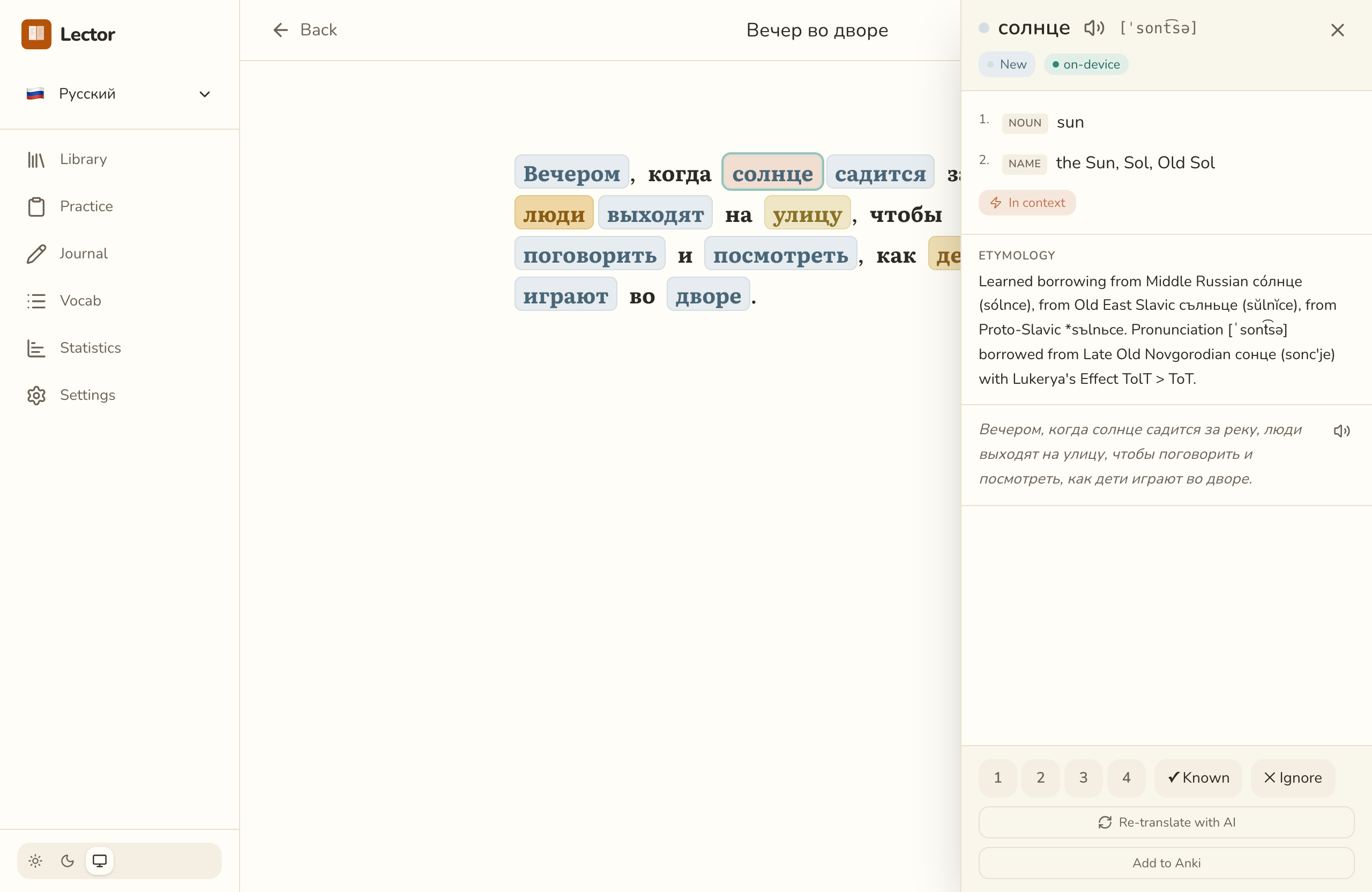
Вечером, когда солнце садится за реку, люди выходят на улицу, чтобы поговорить и посмотреть, как дети играют во дворе.
In the evening, when the sun sets behind the river, people come out into the street to talk and watch the children playing in the yard.
Read it. Practice it. Remember it.
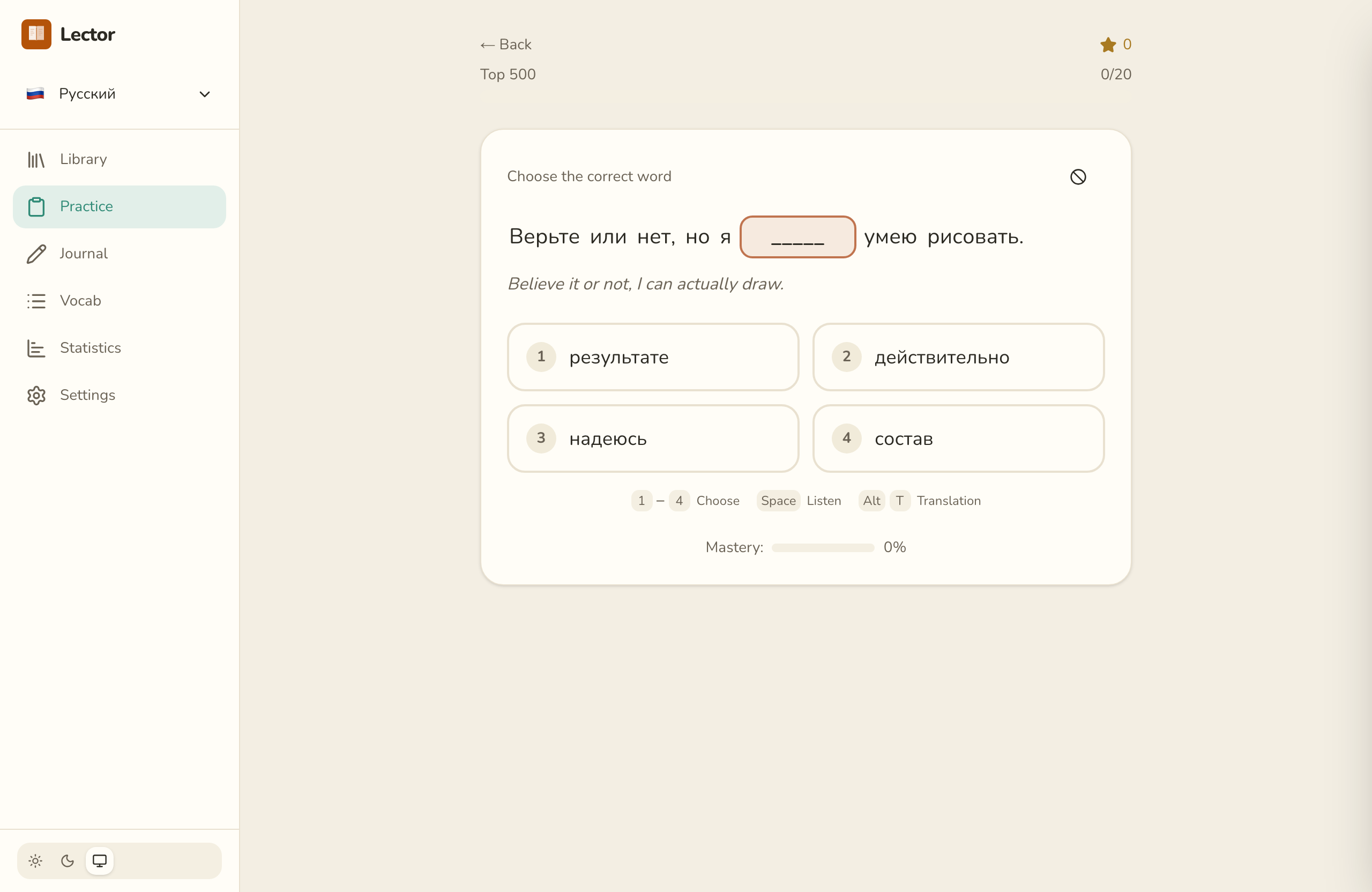
Drill the words that matter first.
Free resources to get you started.
Is Russian hard to learn?
Russian is genuinely challenging for English speakers, in the same tier as Polish and Turkish. Cyrillic takes a week or two and is not the obstacle. The real work is six noun cases, verb aspect, and stress that shifts between forms of the same word.
How long does it take to learn Russian?
The US Foreign Service Institute places Russian in Category III, needing roughly 1,100 class hours (about 44 weeks of intensive study) to reach professional working proficiency. Reading daily brings recognition of common words and simple texts far sooner than that.
What is the best way to learn Russian?
Learn the alphabet first, then read real Russian with lookups a tap away, prioritising the most frequent words and using spaced repetition to keep them. Cases and aspect are learned much faster from thousands of real examples than from paradigm tables.
Can I learn Russian for free?
Yes. Russian has an enormous free corpus — public-domain literature, open courses, news and podcasts — plus free and self-hosted reading tools and spaced-repetition software, so no paid course is required.
Learning Russian? You're in good company.
Start reading Russian today.
Open source to self-host for free, or on our cloud in a click.