Learn Mandarin by reading.
Cloud is in beta · self-hosting is free forever
- Native speakers
- ~990 million
- Difficulty (FSI)
- Category IV
- To proficiency
- ~2,200 hours
Reasons to start.
Around 990 million native speakers and roughly 1.18 billion in total — more first-language speakers than any other language on earth.
One written standard across the whole Chinese-speaking world, and the same characters sit under a large share of Japanese and Korean vocabulary.
No verb conjugation, no noun cases, no grammatical gender, and no plurals. Mandarin grammar is far simpler than its reputation suggests. The script and the tones are the work.
Bonus: Spoken Mandarin is not mutually intelligible with Cantonese, Hokkien or Shanghainese, but they share the written language, so reading carries across the Chinese-speaking world. Lector keys entries on Simplified and resolves Traditional to the same entry, so 這 and 这 both answer zhè.
The honest version.
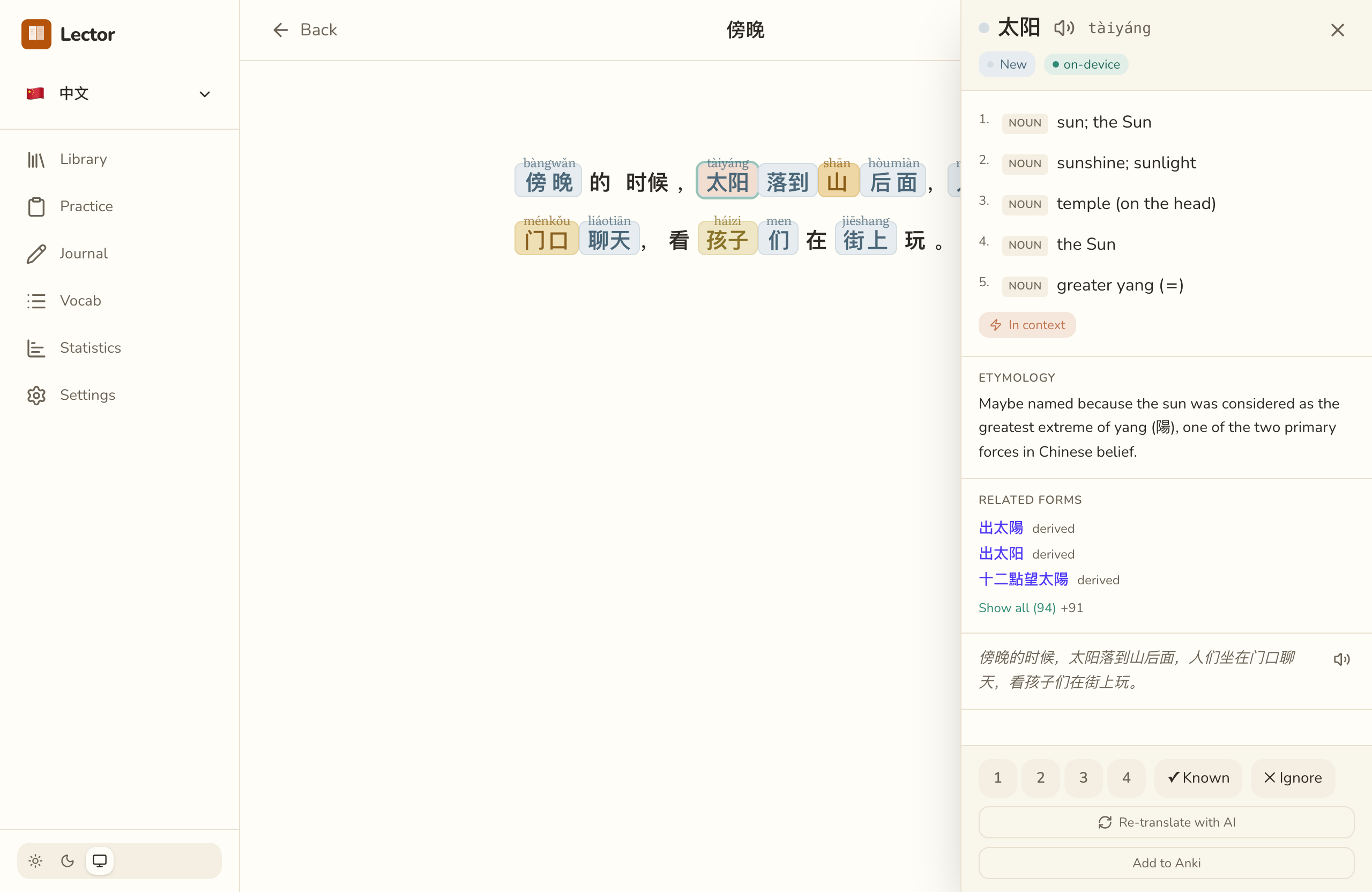
傍晚的时候,太阳落到山后面,人们坐在门口聊天,看孩子们在街上玩。
In the evening, when the sun drops behind the mountain, people sit in their doorways chatting and watch the children playing in the street.
Read it. Practice it. Remember it.
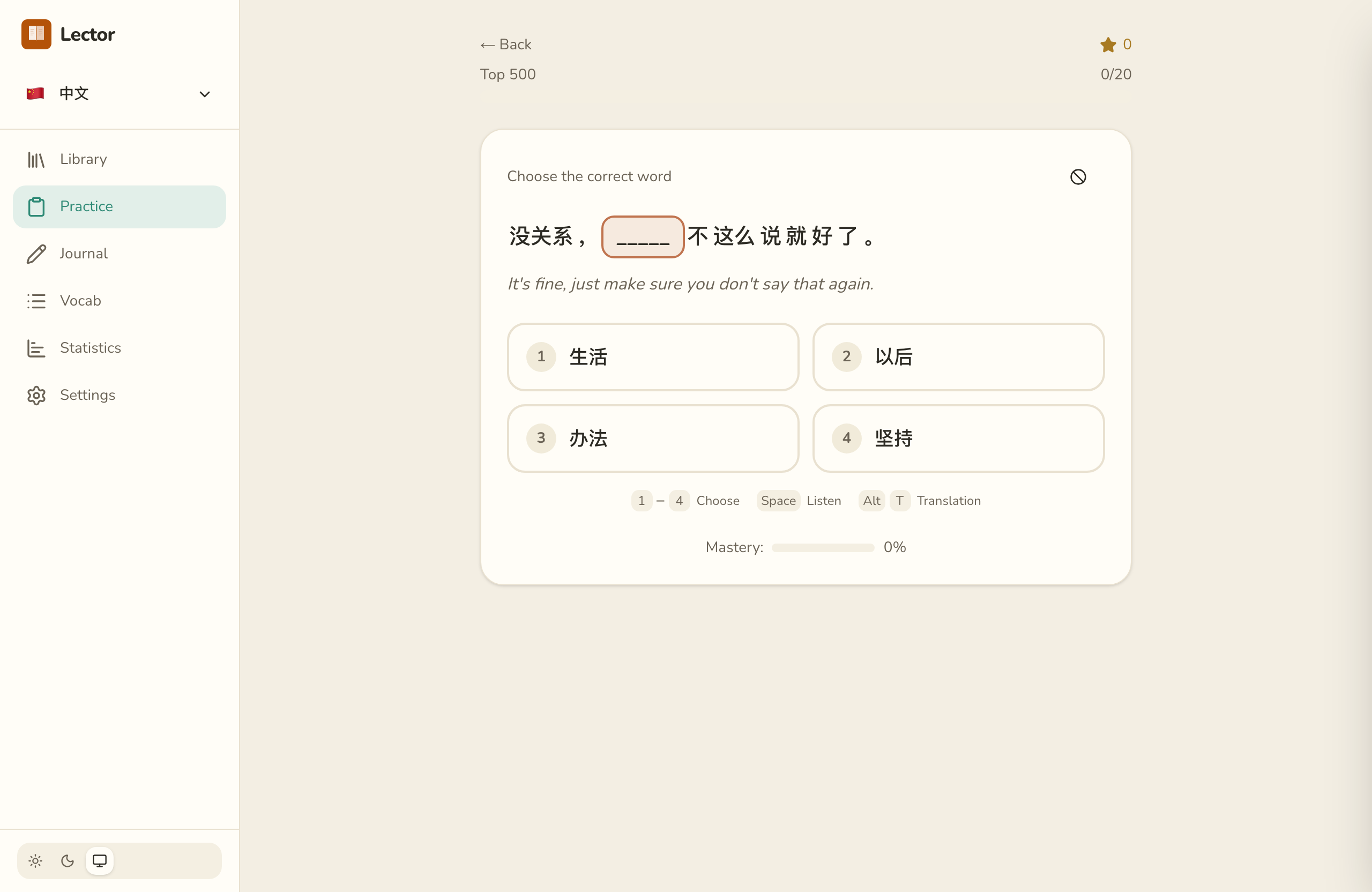
Drill the words that matter first.
Free resources to get you started.
Is Mandarin hard to learn?
Mandarin sits in the FSI's hardest tier, though not because of its grammar. There is no conjugation, no case, no gender and no plural. The difficulty is the tones and the writing system, and both are learned by meeting the same words again and again in context.
How long does it take to learn Mandarin?
The US Foreign Service Institute places Mandarin in Category IV, at roughly 2,200 class hours (about 88 weeks of intensive study) to reach professional working proficiency. Reading with pinyin support and lookups a tap away brings simple texts within reach long before that.
How many Chinese characters do I need to read?
Roughly 2,500 to 3,000 characters covers most everyday text, and the most frequent 1,000 do the bulk of the work. Frequency-ordered practice is the shortest way through that list, which is exactly what a cloze bank ranked by frequency gives you.
What is the best way to learn Mandarin?
Read real Chinese with word segmentation, pinyin above each word, and a tap-to-translate dictionary. Learn the most frequent words first and let spaced repetition return them. Because the reader retires the pinyin once you know a word, the support fades on its own as you improve.
Can I learn Mandarin for free?
Yes. Mandarin has an enormous free corpus — public-domain literature, open courses, news, podcasts and video — and free or self-hosted reading and flashcard tools cover the practice side, so no paid course is required.
Learning Mandarin? You're in good company.
Start reading Mandarin today.
Open source to self-host for free, or on our cloud in a click.