Learn Latin by reading.
Cloud is in beta · self-hosting is free forever
- Native speakers
- None — a historical language
- Difficulty (FSI)
- Not FSI rated
- To proficiency
- ~600 hours
Reasons to start.
It is the language of Caesar, Cicero, Virgil, the Vulgate, and Augustine. Reading them in Latin takes the translator out from between you and the text.
A mapped target: the Dickinson College Commentaries Latin Core Vocabulary ranks about 1,000 lemmas from a large Classical corpus, and those lemmas cover a large share of running prose. Few languages define the job this clearly.
Latin sits under the Romance languages and a large share of English scientific, legal, and theological vocabulary, so Spanish, French, Italian, and academic English all get easier with it.
Bonus: Latin is the parent of the Romance family. Spanish, French, Italian, and Portuguese become far more approachable once the case system and the core lexicon are in place, and a large stock of English academic vocabulary is Latin on sight.
The honest version.
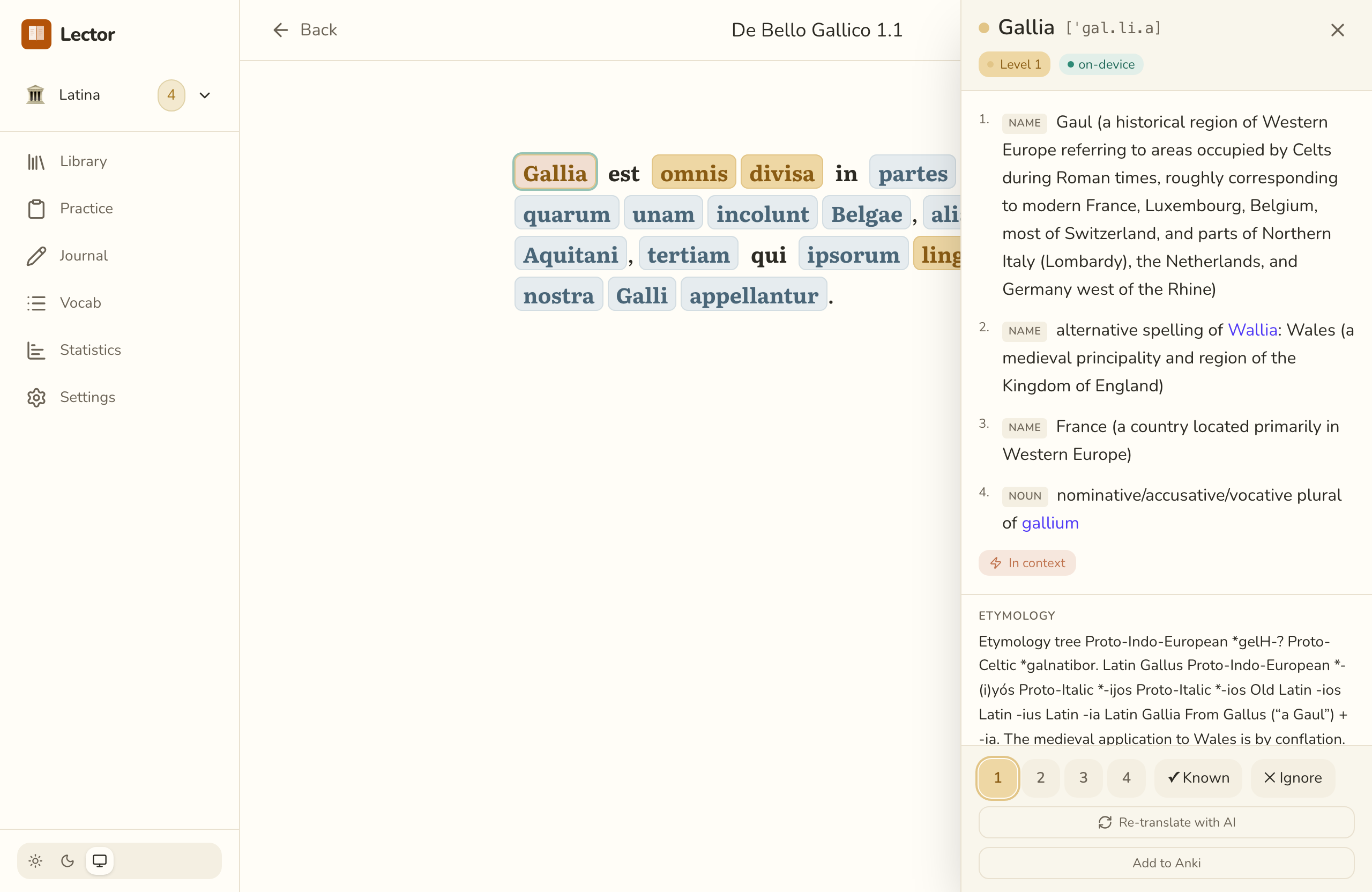
Gallia est omnis divisa in partes tres, quarum unam incolunt Belgae, aliam Aquitani, tertiam qui ipsorum lingua Celtae, nostra Galli appellantur.
Gaul as a whole is divided into three parts, of which the Belgae inhabit one, the Aquitani another, and the third those who in their own language are called Celts, in ours Gauls. (Caesar, Gallic War 1.1)
Read it. Practice it. Remember it.
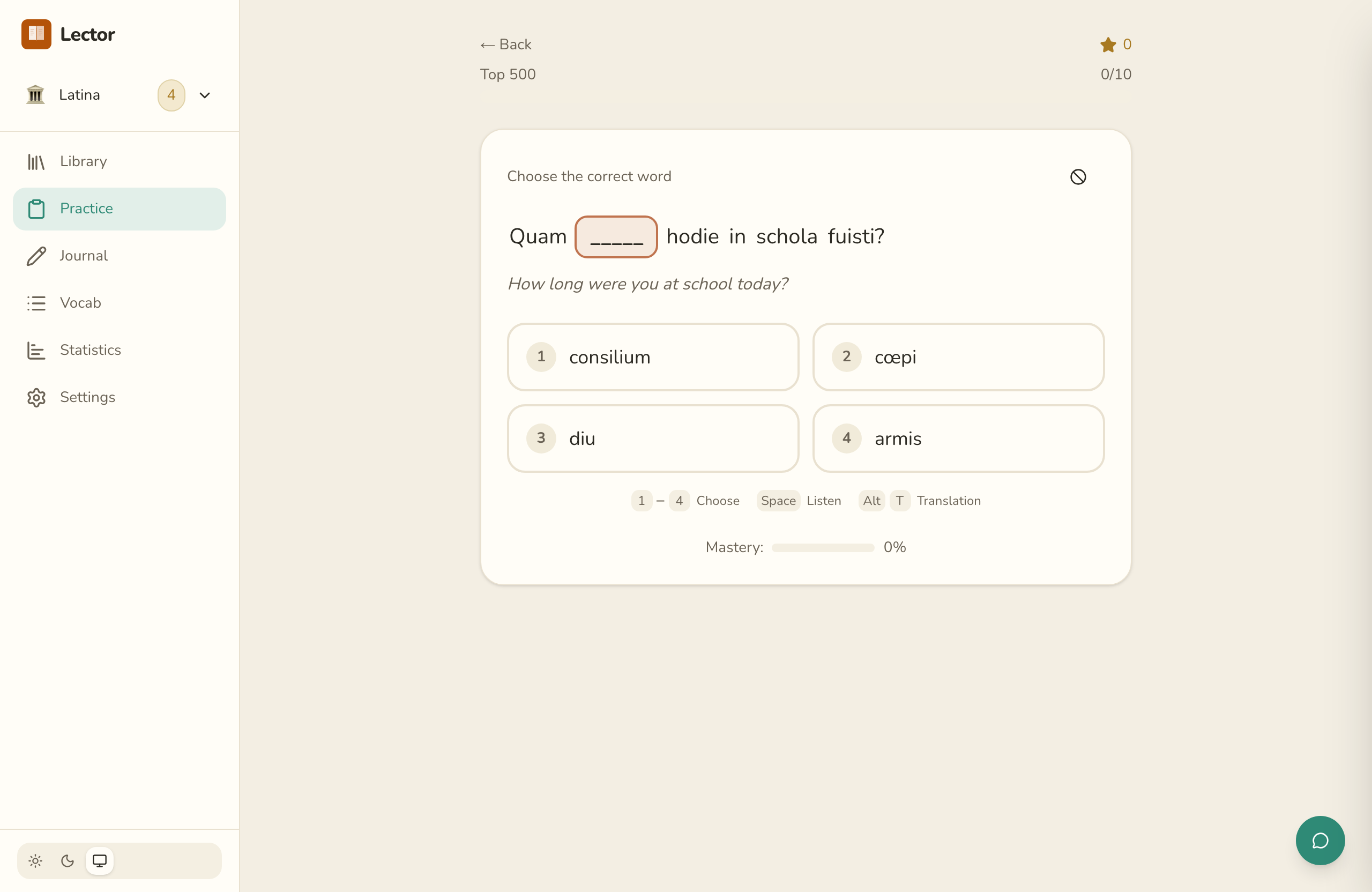
Drill the words that matter first.
Free resources to get you started.
Is Latin hard to learn?
The grammar is demanding — five declensions, six cases, and a verb system English has no direct equivalent for. The vocabulary is the compensating advantage: English already carries a huge Latin stock, so many words are recognised rather than memorised. The target is also narrow. You are learning to read a finite literary corpus, not to hold a conversation, which makes it far more tractable than a modern language of the same grammatical weight.
How long does it take to learn Latin?
There is no FSI figure, because the FSI does not teach historical languages. Unofficial Category II estimates of about 600 hours are a reasonable marker if the goal is reading. Reading-only is a shorter road than that: the DCC core list is about 1,000 lemmas, and those cover a large share of Classical prose, so Caesar's opening chapters become readable within months.
What is the best way to learn Latin?
Read real Latin from the start, with lookups that fold editorial macrons (amāre and amare are one key) and practice that is ordered by the DCC core vocabulary. Learning the highest-frequency lemmas first buys the most text for the least effort. Typed practice accepts unmarked vowels, so you can answer without copying dictionary length marks.
Does Lector read Latin aloud?
No, and that is deliberate. Classical and ecclesiastical pronunciation are both taught, and they disagree, so Lector stays silent rather than teaching you a guess. Every other feature — lookups, cloze practice, mining to Anki — works as it does for any other language.
Learning Latin? You're in good company.
Start reading Latin today.
Open source to self-host for free, or on our cloud in a click.